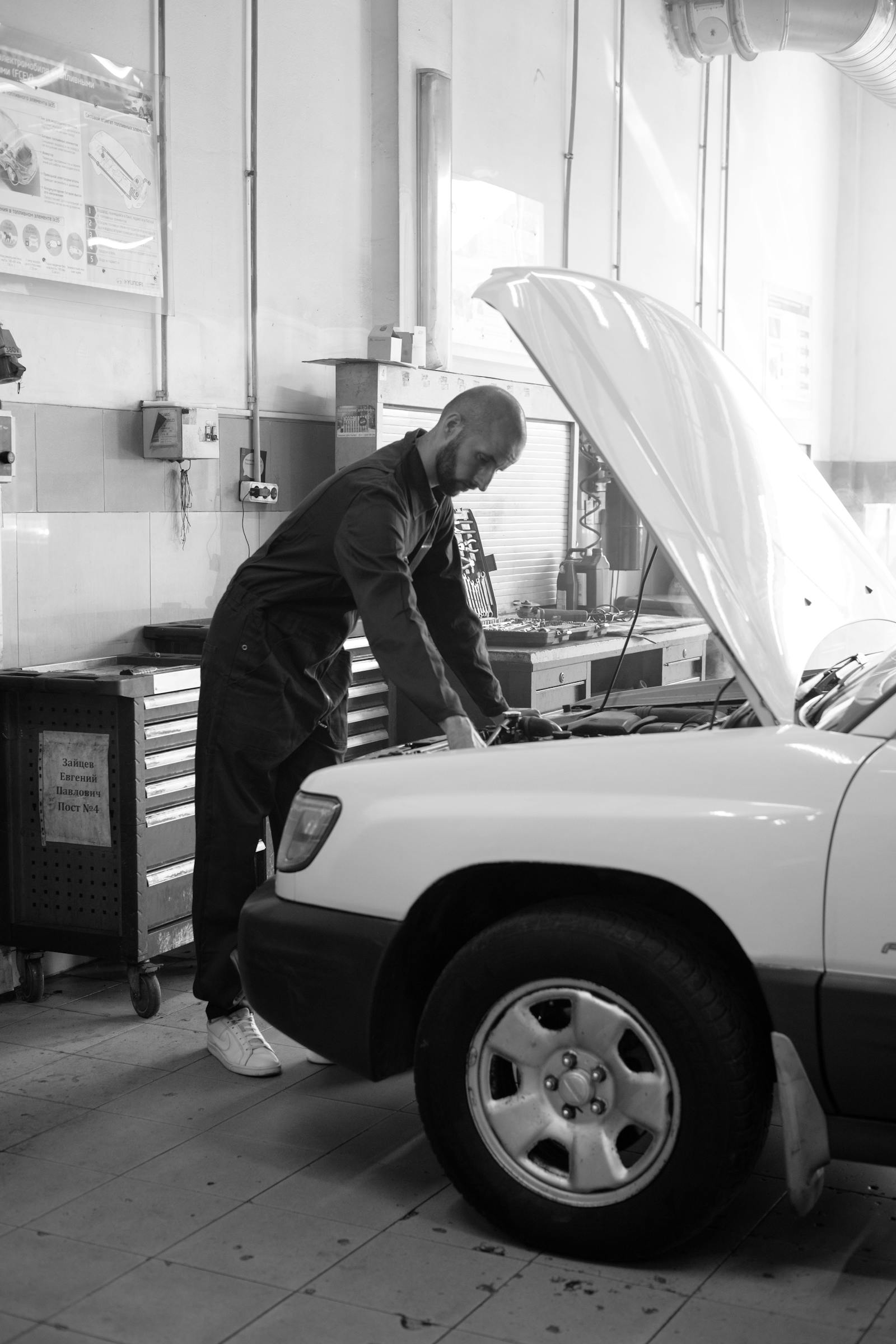
Repair Guides: Tracking Disassembly Without Losing Parts
You're three hours into a timing chain job on a 5.4 Triton. The valve covers are off. There's a Tupperware on the bumper holding sixteen bolts. You've got a paper plate with the cam phasers, an oil-soaked rag with the chain guide hardware, and four more clips in the cup holder of your truck. Your phone rings — it's the next customer, asking if you're still coming at 1pm. You step away. You come back. You stare at the bolts. You no longer know which length goes where.
This is the moment every mobile mechanic eventually has. The moment you realize that disassembly without documentation is just disassembly hoping for the best. The job that should take five hours is now seven because you're double-checking torque specs and matching bolt lengths through trial fits.
Repair guides — also called procedure templates, disassembly logs, or job SOPs depending on who you talk to — are the fix. They're not glamorous. They're not the part of being a mechanic that anyone romanticizes. But they're the difference between repeatable, profitable jobs and the slow attrition of "where did that go" that eats your hourly rate alive.
What a Vehicle Blueprint Actually Is
A vehicle blueprint is a structured, reusable record of how a specific job gets done on a specific vehicle. Not a service manual — a service manual is the OEM's procedure, written for liability. A blueprint is your procedure: the order you actually do the steps, the parts you actually need, the time it actually takes, the photos you took the last time you did it on this exact engine. It lives in the app, attached to the vehicle and to the job type, and gets updated every time you do that job again.
The simplest version is just three columns:
- Steps — disassembly order with notes
- Parts & consumables — what gets used, with line items pre-loaded
- Photos & references — torque specs, hose routings, "this clip goes here"
That's enough to transform a job from "I think I remember how this goes" to "I know exactly how this goes because I built the procedure last time and I'm following my own breadcrumbs."
The Hidden Cost of Working Without a Blueprint
Most mobile mechanics underestimate what unstructured disassembly costs them. It doesn't show up as a line item on any P&L. It shows up in a hundred small leaks:
- Re-buying the bolt or clip you lost. Average AutoZone trip: 25 minutes round trip. Cost of part: $4. Cost of your time: $40. Recurring weekly.
- Reusing a hardware kit because you can't remember if the customer already has one in their box. $50 in parts you didn't need to buy.
- Re-doing torque on a fastener because you weren't sure what spec you used. 15 minutes plus stress.
- Quoting a job at 4 hours and discovering it's actually 6.5. Two and a half hours of unbilled labor on a job you'll lose money on.
- Forgetting to charge for shop supplies. Across a year, this is hundreds of dollars in unbilled consumables.
- Coming back tomorrow because you forgot a part. A second trip you can't bill for.
One careful blueprint per job type kills all six of those. The first time you do a job (let's say "rear main seal on a 6.7 Powerstroke"), you spend an extra 20 minutes building the blueprint as you go. Every subsequent time you do that job, you save 30-90 minutes. The math compounds fast.
The Fastener Problem (and How Photos Solve It)
The single biggest source of disassembly chaos is fastener tracking. Most modern vehicles use four or five different bolt lengths in the same engine bay region, plus T-shanked stretch bolts you can only use once, plus torque-to-yield bolts that need replacing. Lose track of which bolt came from where and you're either reaching into a parts bin and guessing, or back-tracking through a Mitchell diagram.
The fix is shockingly low-tech: photograph every fastener cluster before you remove it. Wide shot, then close-up of the bolts in their holes with a label or a piece of tape. Then bag the bolts in a labeled zip-top, and attach the photo to the blueprint step.
You will feel ridiculous doing this on the first job. By the third job, you'll feel like a genius — because reassembly takes a third of the time, and you stop second-guessing torque sequence on jobs you only do twice a year. The Trackara Pro Repair Guides module lets you snap photos directly into a step from your phone, so the photo lives with the procedure forever.
A real disassembly photo log: front timing cover removal
- Step 4 photo: serpentine belt routing (before removing tensioner)
- Step 7 photo: harmonic balancer bolt orientation + 3/8 keyway position
- Step 9 photo: timing cover bolt pattern with bolts in holes, tagged A-N
- Step 9 note: "bolts B/F/J are 1mm longer — don't mix"
- Step 11 photo: cam timing marks aligned, before removing chain
- Step 12 note: "torque to yield, do NOT reuse — replace from kit"
That's 60 seconds of photos saving you 60 minutes of "wait, where did this come from."
Pre-Loaded Parts and Line Items: Where Blueprints Pay Off
The other half of a blueprint isn't the procedure — it's the parts list and labor breakdown that come pre-loaded with the template. When you create a blueprint for, say, "front brake pads & rotors on a 2018-2024 Ford F-150 4WD," you attach:
- 2x rotors (with your supplier's preferred SKU + cost + your markup)
- 1x pad set
- 2x caliper bracket bolts (one-time-use)
- 1x hardware kit
- 1x bottle of synthetic brake grease (consumable)
- 4x lug nuts (sometimes one-time-use on aluminum wheels)
- Labor: 1.4 hours (your real time, not the book time)
- Shop supplies fee: $12
Now when a customer books that exact job through your online booking page or calls in, you load the blueprint, every line item populates the quote or work order, the price calculates with your markup, and you're handing the customer a quote in 60 seconds. No "let me get back to you with a price." No forgetting to charge for the hardware kit.
This is the unsung profit-protector of mobile mechanics. Most underbilling happens not because the mechanic intentionally undercharges — it happens because they forget to add the $14 hardware kit, the $9 synthetic grease, the $12 shop supplies fee, the $8 in zip ties and clips. Across 200 jobs a year, the missing $30-$50 each adds up to $6,000-$10,000 in pure margin you didn't bill. A blueprint with pre-loaded line items eliminates that loss permanently.
Time Estimates That Actually Match Reality
Mitchell, AllData, and Motor's labor guides are written for shop technicians using lifts, air tools, and a parts crib down the hall. They're a starting point. They are not what your driveway/customer's-driveway reality looks like. A "1.0 hour" book job often takes a mobile mechanic 1.5-2.0 hours because of the setup time, parking awkwardness, and lack of a lift.
The blueprint stores YOUR real time, not the book time. The first time you do "front struts on an Outback," you log that it took you 3.2 hours. Next time it's 2.8. The blueprint averages your last few times and gives you a realistic estimate for quoting. Within 10-15 jobs, your guides are calibrated better than any third-party labor guide for your specific work conditions.
This matters most when quoting through Thumbtack or to a returning customer. If you've been quoting front struts at 2.0 hours because that's what the book says, and they actually take you 3.0 hours, you're paying yourself 33% less than your hourly rate. Your Thumbtack quoted reply only works if the time number is real.
Try Trackara Pro
Trackara Pro's Repair Guides store steps, parts, time, and photos for every job you've done. Reuse them on the next customer with the same vehicle. Quotes pre-fill. Disassembly stops eating your day.
Start Your 14-Day Free TrialBuilt for the van, not the bay · Cancel anytime
Building Your First Five Blueprints
Don't try to blueprint everything at once. The 80/20 rule: pick the five jobs you do most often, and build a blueprint for each one over the next month. After that, you'll have a blueprint covering roughly 60% of your weekly work.
The first five guides every mobile mechanic should build
- Front brake pads & rotors — different guides per common vehicle (F-150, Tahoe, Silverado, RAM 1500, Camry, Civic)
- Battery + charging system replacement — battery, alternator, terminals as a combo template
- Oil & filter change — yes, even this. You're losing $5/job in shop supplies you forgot to bill.
- Spark plug replacement — split by 4-cyl / V6 / V8 because the labor times are different
- Diagnostic visit — not really a procedure, but a template to capture intake form, scan tool report, customer signature, recommended next steps
Once those five exist, every subsequent blueprint takes 15 minutes to build because you're cloning and adjusting an existing one.
Photo Documentation: Customer-Facing Proof
Blueprints aren't just for you — the photos in them are also evidence for the customer. When you finish a job and email a customer their digital inspection with before/after photos, those photos came from the blueprint workflow. The customer sees a professional, documented job. You build trust. You also have a permanent record of what condition the vehicle was in when you started, which matters in the rare case a customer claims you damaged something you didn't touch.
This dovetails directly with the proof-of-service capture at the end of the job: signature, post-job photos, completion timestamp. Together with the blueprint, you've got a complete chain from "customer booked" through "blueprint executed step-by-step" to "customer signed off." There is no version of this that involves more paperwork than the alternative — the alternative is the back-and-forth, the disputes, the "I never saw the dash light before."
Blueprints vs. Service Manuals: Use Both
A blueprint is not a replacement for AllData, Mitchell1, Identifix, or the OEM service info. Those are your reference for torque specs, fluid capacities, capacity charts, TSBs, and recall data. Your blueprint references those — it doesn't replicate them. A typical blueprint step might say:
"Step 9 — Torque cylinder head bolts in 3 stages per OEM sequence (see Mitchell1 — engine - 5.7L - cylinder head - torque sequence). Stage 1: 22 lb-ft. Stage 2: 90°. Stage 3: 90°. Replace bolts; do not reuse."
That's enough to remind you what you did, with a pointer back to the canonical source. The blueprint is the index of how YOU do the job. The OEM info is the source of truth on how the manufacturer says to do it. Use both.
The Crew Multiplier: Blueprints as Training
If you ever bring on a second mechanic — a partner, an apprentice, a 1099 helper — your guides become training documents on day one. Instead of "shadow me for two weeks until you've seen everything," it's "load the blueprint, follow the steps, ask me when you hit a step that's unclear." This is also where crew step-by-step guides start to matter, because once you have a second person clocked in on a blueprinted job, you can actually measure whether the labor time is matching.
Even for solo mechanics, this matters: if you ever sell the business, the guides are 60% of what makes it sellable. A truck and a route are worth maybe $40K. A truck, a route, and a documented operations playbook with 80 guides is worth $120K to a buyer who can step in and run it without you.
Common Objections (and Why They're Wrong)
"I don't have time to document while I'm working."
You don't have time NOT to. The 20 minutes of documentation on a first run pays back the second time you do that job. By job four, you've broken even on every blueprint you've built.
"Every car is different."
Within a make/model/year range, almost every car is the same. A 2015-2020 F-150 brake job is functionally identical across that range. Build the blueprint at the trim/year-range level, not the individual VIN level.
"I'm fast enough already."
You're fast on the jobs you do every week. Blueprints aren't for those. They're for the jobs you do twice a year — the head gasket, the timing chain, the rear differential — where you're slower because you're rusty. Those are the jobs guides rescue.
"I don't want to share my methods."
Your guides are private. They live in your account on your phone. Nobody sees them but you (and any crew you choose to give access). You're not posting them to YouTube; you're saving yourself two hours next time.
Wrapping Up: Build the System, Then Use It
Repair guides aren't a magic-bullet feature. They're a discipline. The mechanics who get value from them are the ones who actually open the app on the first job, build the procedure as they go, and reference it on the next job. The mechanics who don't are the ones who keep losing $40 alignment shims and re-buying the same hardware kit.
Pick one job this week. The job you do most often. Build a blueprint for it on the next customer who books it — steps, parts, photos, time. Run the blueprint on the customer after that and watch how much faster you go. By the third job in that template, you'll be quoting from the blueprint, billing accurately, and finishing on schedule for the first time in a while.
Built for the van, not the bay. The job goes faster when you stop losing the bolts.